This guideline provides educators and researchers with a framework for addressing Artificial Intelligence verification, academic integrity, and responsible evaluation practices in Higher Education. It focuses on evidence-based verification, transparency, methodological judgement, and the prevention of AI-related accusations becoming instruments of harassment, reputational damage, or factional conflicts within research communities.
Rather than assuming that the presence or alleged use of Artificial Intelligence represents academic misconduct, this approach emphasises that AI-related concerns must be examined through reliable evidence, transparent procedures, and disciplinary standards. Verification should strengthen academic integrity, not become a mechanism for personal attacks, professional exclusion, or conflicts between competing groups of researchers.
Understanding the Challenges
-
AI use and unsupported accusations:
Claims that researchers have used Artificial Intelligence improperly require evidence and contextual analysis. Assumptions based only on writing style, productivity, or personal disagreements may lead to unfair judgments.
-
Limits of detection methods:
AI detection tools may produce uncertain results and should not be treated as definitive proof of misconduct without additional verification, scholarly review, and examination of research practices.
-
Academic conflicts and reputational harm:
In environments marked by competing schools, institutions, or research factions, allegations of AI use may become tools for undermining colleagues rather than improving research standards.
Developing Critical AI Verification Literacy
-
Verification as a core academic skill:
Researchers and students should learn to evaluate sources, references, arguments, data, writing processes, and methodological decisions rather than relying on suspicion or automated judgements.
-
Transparent AI practices:
Academic communities should promote clarity about when, why, and how AI tools are used in research, teaching, writing, and analysis.
-
Critical evaluation of evidence:
AI-related concerns should distinguish between acceptable assistance, methodological weaknesses, accidental errors, and intentional misuse.
Guidance for Educators and Researchers
-
Prioritise evidence-based review:
Evaluate possible AI misuse through research documentation, sources, drafts, methodology, citations, and scholarly practices rather than isolated indicators.
-
Promote fair academic dialogue:
Address concerns through discussion, peer review, and institutional procedures instead of public accusations or harassment campaigns.
-
Protect research communities:
Encourage environments where disagreement about methods, theories, or interpretations does not become confused with evidence of AI misconduct.
Possible Uses
- Developing institutional frameworks for transparent AI verification practices.
- Training researchers and educators to evaluate AI-related claims responsibly.
- Creating guidelines that distinguish academic integrity concerns from interpersonal or factional conflicts.
- Supporting workshops on AI literacy, evidence evaluation, and responsible scholarly communication.
- Designing fair procedures for addressing suspected inappropriate AI use.
Transferability:
The principles presented here are applicable across disciplines because verification, transparency, evidence-based judgement, and protection against unsupported accusations are fundamental components of academic integrity in any research environment.
Access the Infographic
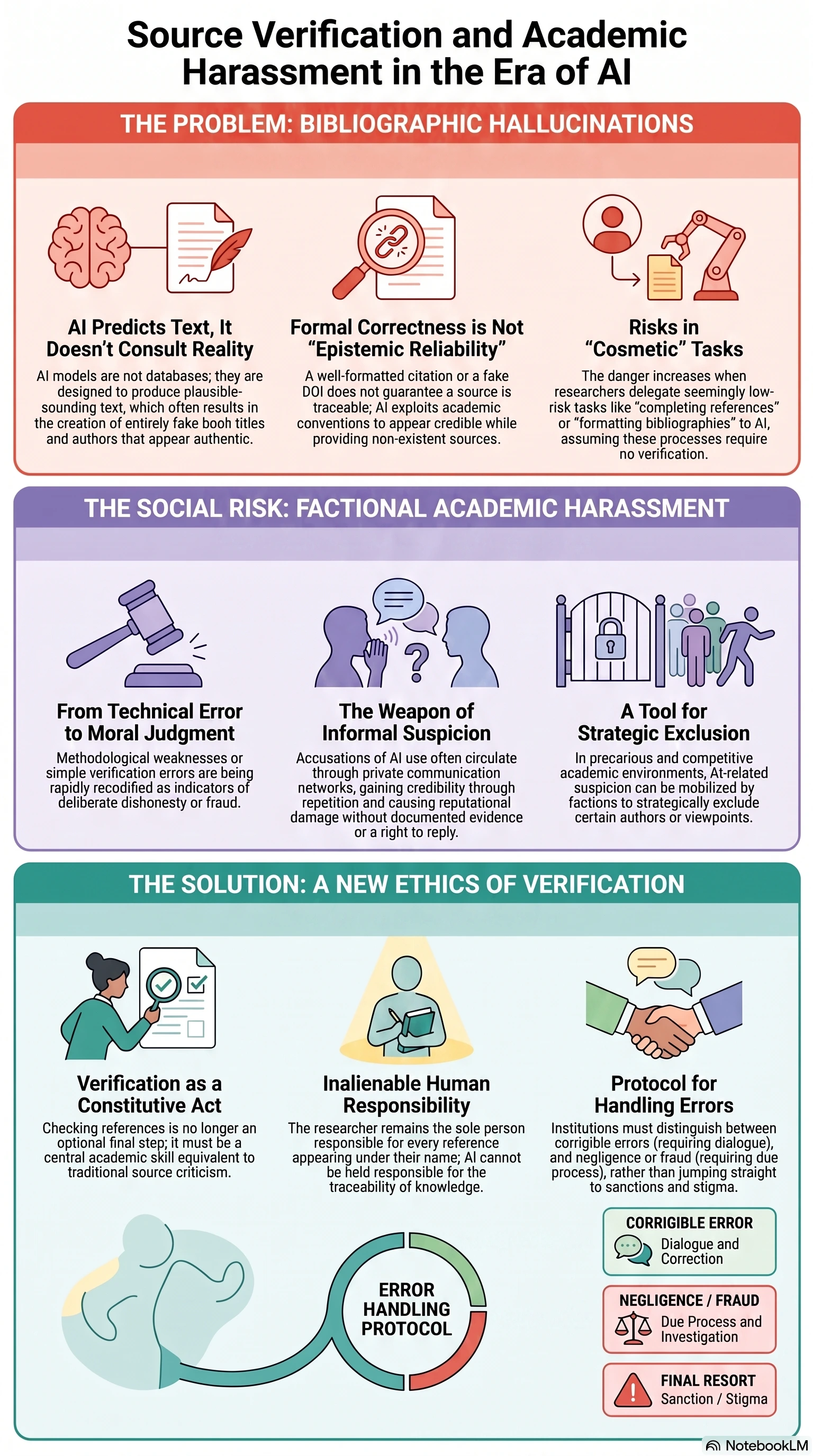
The infographic provides a concise visual framework for discussing AI verification, academic integrity, evidence evaluation, and responsible scholarly communication. It can be used in researcher training, institutional workshops, doctoral programmes, and discussions about ethical AI practices.
Implementation Guide
Step 1 — Explore:
Review the infographic and publication to understand the distinction between AI assistance, methodological limitations, and evidence-based academic evaluation.
Step 2 — Adapt:
Use the framework to develop institutional policies, classroom discussions, researcher training activities, or responsible AI guidelines.
Step 3 — Apply:
Promote transparent, fair, and evidence-based approaches when addressing possible AI-related concerns in educational and research environments.
How to Cite and Attribute This Resource
Use this citation when referring to the infographic in research articles, academic discussions, institutional documents, teaching resources, workshops, or professional development activities.
Center for the Innovation in Ancient Worlds & Heredia Chimeno, C.
(2026).
CIAW Teaching Infographics: Inclusive Learning, Critical AI Literacy, and Responsible Knowledge Practices
[Infographic:
Source Verification and Academic Harassment in the Era of AI
].
Zenodo.
https://doi.org/10.5281/zenodo.21763472
For classroom and research use:
This resource can support discussions about AI literacy, academic integrity, research ethics, doctoral training, institutional policy development, and responsible scholarly communication.
Suggested attribution:
"Adapted from CIAW Teaching Infographics: Inclusive Learning, Critical AI Literacy, and Responsible Knowledge Practices (2026), Center for the Innovation in Ancient Worlds & Heredia Chimeno, C."